

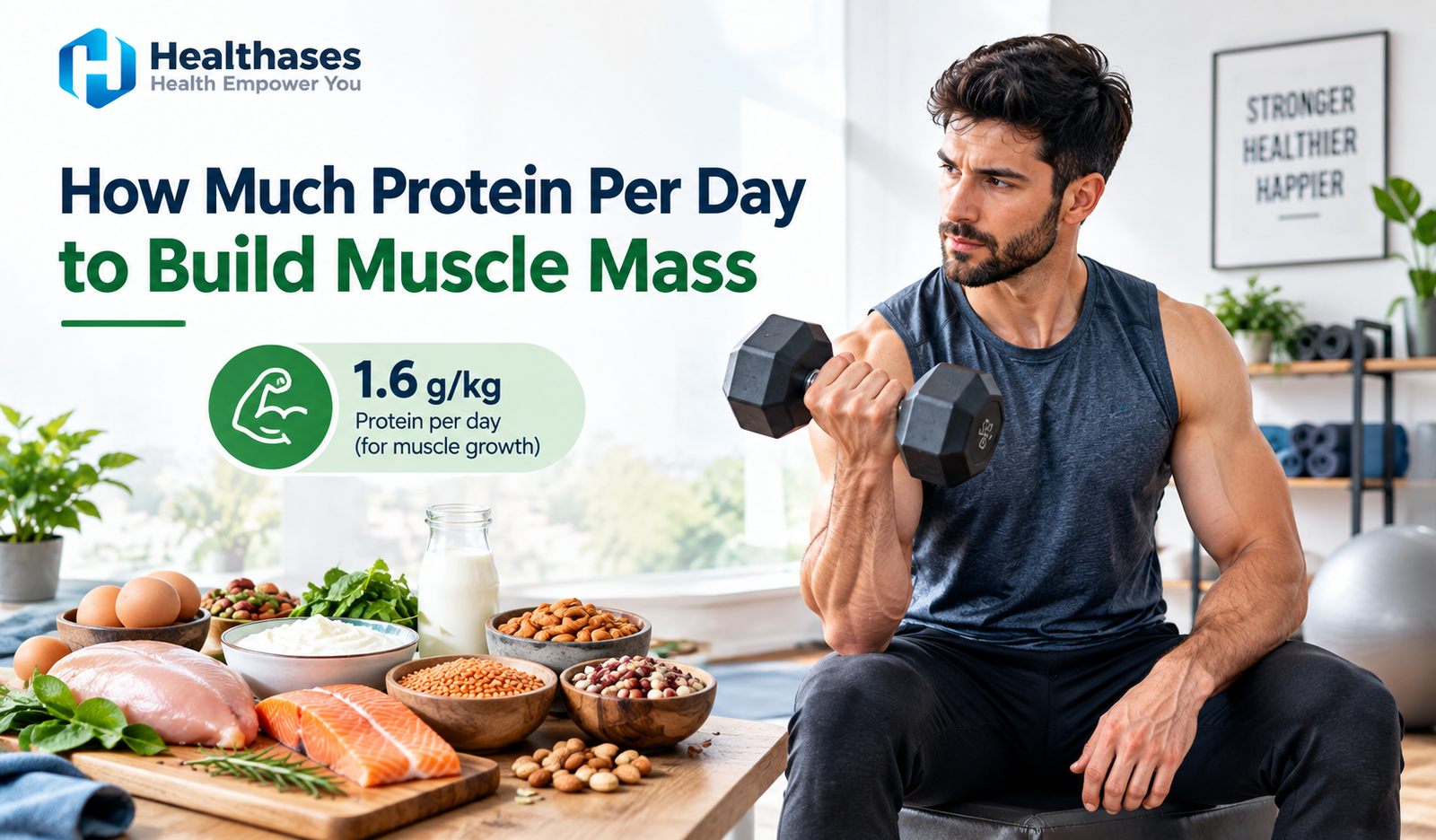
For most healthy adults who lift weights often, a workable daily protein goal for how much protein per day to build muscle mass is about 1.6 grams of protein per kilogram of body weight per day. That said, people can land a bit higher or lower depending on their situation.
Studies generally show that when you eat more protein during a strength program, you may see better gains in lean tissue and strength. When protein goes way past that point, muscle growth does not always keep climbing.
Protein is important because your muscles use amino acids to heal and rebuild after workouts. Still, food alone does not “make” muscle. Lifting is the trigger. Your results depend on several pieces working together, including calories, protein intake, sleep, and recovery time.
This guide Healthases.com covers the idea of how much protein per day to build muscle. It also looks at how to estimate your amount, how to spread protein across meals, whether supplements are really needed, and what to know when protein intake gets very high.
Key Takeaways
- For many adults who lift weights regularly, a common muscle-building goal is about 1.6 g per kg per day.
- People who are athletes or very active can use a wider range, roughly 1.2 to 2.0 g per kg/day. This depends on how they train and on their own situation.
- Protein works best when paired with progressive resistance training.
- Instead of taking most protein in one sitting, spread intake over several meals.
- There is not one clear, agreed-upon top limit for protein in healthy adults. Still, having more does not always help.
- If you have kidney disease or another medical condition, talk with a healthcare professional about your protein goal.
How Much Protein Per Day to Build Muscle Mass Based on Body Weight
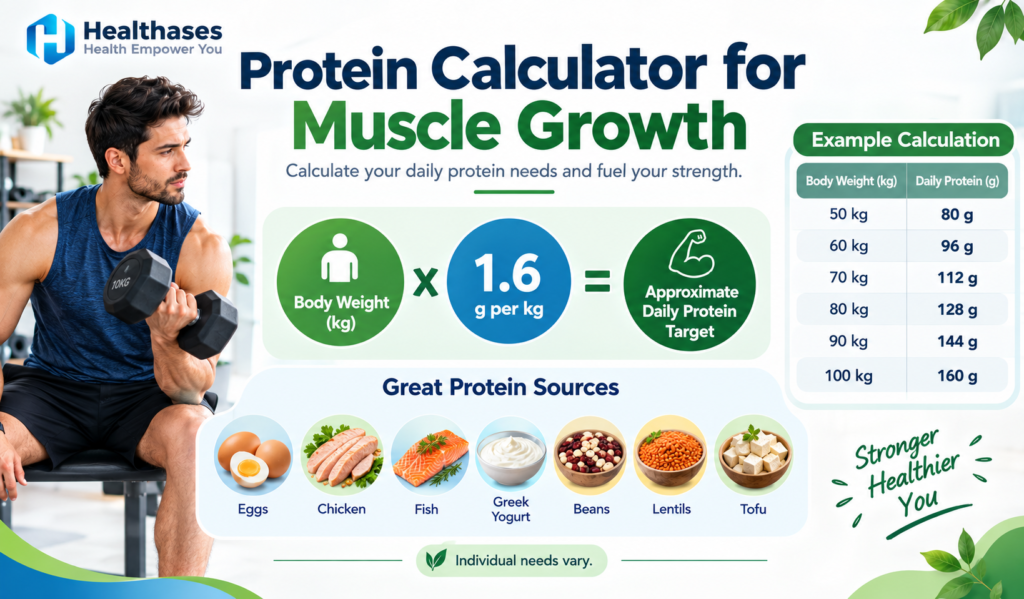
A quick way to guess how much protein you need is to take your weight in kilograms and multiply it by your protein goal.
If you want to build muscle, many people start with about 1.6 grams per kilogram each day. This value is backed by research. In one big review of studies, adding protein during resistance training helped people gain strength and increase fat-free mass. The review also noted that when intakes went above around 1.6 g/kg/day, the studies did not show extra fat-free mass gains.
For more details, read our recent article on “Transform Your Body With a 7 Day Protein Diet Plan for Weight Loss”.
How Much Protein Per Day to Build Muscle: Simple Calculation
Body weight in kg × 1.6 = approximate daily protein target
| Body weight | Approx. protein at 1.6 g/kg |
| 50 kg | 80 g |
| 60 kg | 96 g |
| 70 kg | 112 g |
| 80 kg | 128 g |
| 90 kg | 144 g |
| 100 kg | 160 g |
If a person is 70 kg, a reasonable starting point is about 112 g of protein each day, assuming they stick with the same resistance training routine.
This is not a set rule. Your age, how much you train, how many calories you eat, your body makeup, your goals, and any health issues can change what you should aim for.
Protein Per Day to Build Muscle: What Does Research Suggest?
For healthy adults, the usual daily protein target is not as high as what many people chase when they want bigger muscles. Most guidance for adults is close to 0.8 g/kg/day. The NIH Office of Dietary Supplements also says that people who train may end up needing more, about 1.2 to 2.0 g/kg/day, especially to help the body repair and rebuild muscle and handle training changes.
This gap matters.
- If you do not exercise often, you may not need the same amount as someone who lifts weights four or five times each week.
- Studies on resistance training suggest that eating more protein can lead to modest gains. It may help increase lean body mass a bit, and it can improve some strength measures. Still, the benefit does not go on forever.
How Many G of Protein Per Day to Build Muscle?
It depends on your weight if you want to know how many grams of protein each day you should aim for to gain muscle.
Here is a simple guide based on 1.6 g per kg:
- 60 kg: about 96 g each day
- 70 kg: about 112 g each day
- 80 kg: about 128 g each day
- 90 kg: about 144 g each day
You don’t need to hit the exact amount every single day. Use it as a general goal that helps you stay on track.
How to Use a Protein Calculator for Muscle Growth
You can use a basic protein calculator to make the math quick. Still, you do not need a complex app.
First, use your body weight in kilograms.
If your weight is in pounds, divide it by 2.205. That gives an estimate in kilograms.
Next, take your weight in kilograms and multiply it by the protein amount you plan to use.
Example:
75 kg × 1.6 g = 120 g of protein each day
If you train very hard, you might pick a higher value from the usual athlete range. If your training is lighter, you may choose a lower value.
Protein Calculator Example
| Weight | 1.2 g/kg | 1.6 g/kg | 2.0 g/kg |
| 60 kg | 72 g | 96 g | 120 g |
| 70 kg | 84 g | 112 g | 140 g |
| 80 kg | 96 g | 128 g | 160 g |
| 90 kg | 108 g | 144 g | 180 g |
The middle column is a handy place to begin for many adults who train with resistance.
| Expert Tip: Do not add more protein if your training plan stays the same. Protein for muscle growth works best with steady strength training, enough calories, and time to recover. |
How Many Grams of Protein Per Day to Build Muscle From Food?
A lot of people wonder how many grams of protein per day they need to build muscle. Still, the more useful question is how to hit your goal each day with good food. You can get protein from animal-based foods and from plant sources.
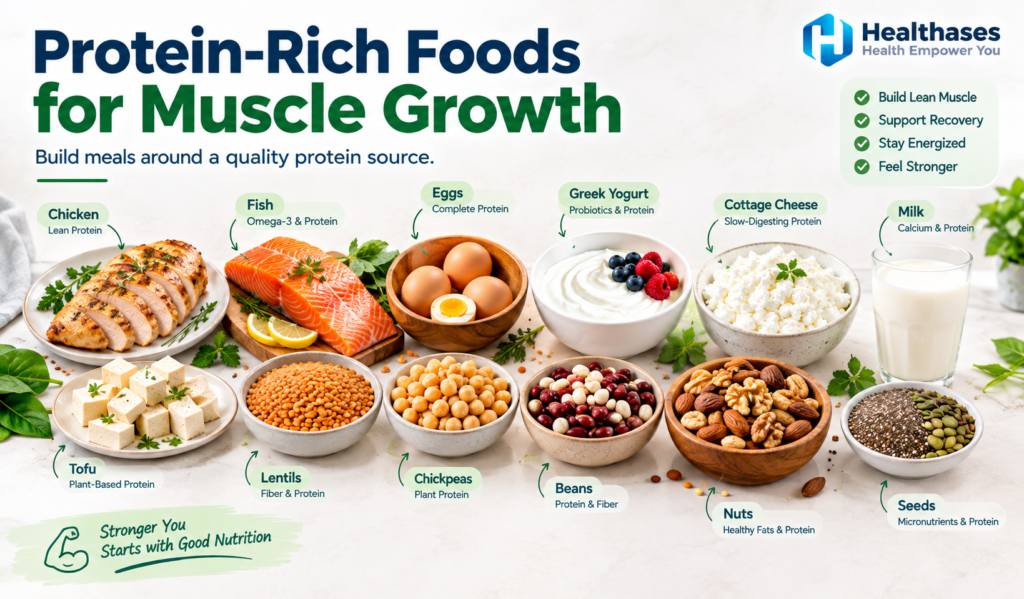
High-Protein Foods for Muscle Building
- Eggs
- Chicken
- Turkey
- Fish
- Seafood
- Greek yogurt
- Cottage cheese
- Milk
- Lean beef
- Tofu
- Tempeh
- Lentils
- Chickpeas
- Beans
- Soy foods
- Nuts
- Seeds
Meat, fish, eggs, and dairy usually have all the essential amino acids.
Plant foods can still help a lot too. This is more likely when you eat a mix of foods, like legumes, grains, soy foods, nuts, and seeds.
A balanced diet can therefore provide protein for muscle growth without requiring protein shakes.
Read our recent blog on “Healthy Foods to Eat for Weight Loss: 23 Best Science-Backed Options”
How to Spread Protein Throughout the Day
Protein matters for recovery, but you still do not have to eat all your daily total right after training.
The NIH Office of Dietary Supplements says sports nutrition plans often use about 0.3 g per kg of protein after you finish, then again every 3 to 5 hours. If you weigh 70 kg, that number comes to roughly 21 g.
One easy way to fit it in could be:
| Meal | Example protein target |
| Breakfast | 25–30 g |
| Lunch | 25–35 g |
| Snack | 15–25 g |
| Dinner | 30–35 g |
This method can help you hit your required protein intake per day. It also avoids needing very large servings in just one meal.
Say your target is around 120 g. You could split it across four meals instead of trying to eat 70 to 80 g at dinner.
Required Protein Intake Per Day: Does Age Matter?
No. Adults do not all need the same protein.
As people get older, their bodies often lose muscle more easily. That is why some older adults may need extra protein to slow this down. ESPEN says older people should get at least 1.0/g/kg/day. Many healthy older adults are often advised to aim for around 1.0 to 1.2 g/kg/day. In some cases, such as illness or time spent recovering, doctors may suggest more.
So, your protein intake per day goal should not come only from what you do in the gym.
Your protein needs depend on your age and overall health. They also change with your activity level, how hungry you feel, your body makeup, and any medical conditions you have.
If you are older and you want to build strength or keep muscle, lifting weights plus enough protein can help a lot.
What Is the Max Protein Intake Per Day?
No one agrees on a max protein intake per day number that fits every healthy adult.
In the United States, the National Academies suggest about 0.8 g per kg of body weight each day. The NIH says there is not a known upper limit. It adds that harm from too much protein in food seems unlikely. Still, it warns that research on very high intakes over many years is thin.
Also, higher protein does not always lead to more muscle. A big review of resistance training studies did not find extra lean tissue gains once intakes went above around 1.6 g/kg/day.
So rather than hunting for the largest figure, aim for a protein level that helps your workouts and still works well within a normal balanced diet.
Is Very High Protein Safe?
Some studies in healthy adults have not found strong proof of kidney harm from eating more protein. Still, these studies have limits. For people eating very high amounts over long periods, the full picture is not fully clear.
A review done in 2026 looked at many papers and did not find clear, repeated lab signs of kidney injury in adults who do not already have chronic kidney disease. Even so, many of the included studies ran for a short time. A lot of them also used creatinine tests, which can be less reliable on their own.
If you have chronic kidney disease, or a different issue that changes how your body handles protein, do not just copy a high-protein diet meant for bodybuilding. Talk with your clinician. They can help you pick a protein goal that fits your situation.
Protein Supplements: Do You Need Them?
Protein powder is optional. It is a shortcut, not a must.
Whey, casein, soy, and other supplements can help you hit your daily protein goal when normal meals are hard to fit in. That said, normal meals bring more than protein. They also give you vitamins, minerals, healthy fats, carbs, and other nutrients.
A simple plan is to start most meals with a protein source. Then, add a supplement only when it truly helps you stick to your day.
One way to do it:
- Breakfast: eggs, whole-grain toast, yogurt
- Lunch: chicken, rice, vegetables
- Snack: Greek yogurt, fruit
- Dinner: salmon, potatoes, vegetables
With this, you can get a strong protein intake without turning every meal into a shake.
5 Practical Tips for Protein for Muscle Growth
Protein helps muscle build, but showing up day after day matters more than chasing a perfect plan.
1. Set a realistic daily target
Use your body weight and how you train now to set a number that feels realistic. Don’t jump to a huge target in one day.
2. Include protein in every main meal
You can use eggs, yogurt, fish, chicken, tofu, beans, and lentils. These foods make it easier to hit your daily goal without forcing it.
3. Train progressively
Protein will not replace lifting and other resistance work. Increase the challenge over time, so your muscles get a reason to adapt.
4. Don’t forget total calories
If your goal is more muscle, eating too few calories every day can slow you down. Protein is important, but it is not the only piece.
5. Give your body time
Muscle gains take time, often weeks and months. Look at training results, strength changes, body measurements, and how you recover. Don’t expect fast shifts overnight.
How Much Protein Per Day to Build Muscle: Common Mistakes to Avoid
Many people think that if they eat twice as much protein, their results will also double. The research does not back up that belief.
You might also run into other problems, like these:
- Skipping protein most of the day, then trying to make up for it at night.
- Relying only on protein shakes.
- Cutting carbohydrates and fats while keeping protein high.
- Eating too little overall when the goal is to build muscle.
- Switching workouts too often.
- Paying more attention to supplements than to steady training.
- Using the same protein number for every body type and situation.
- Following a high-protein plan while you have a health issue that needs meal advice tailored to you.
How much protein per day to build muscle is just one part of the picture. It’s not just training that counts. Recovery has to be solid as well. Overall food quality and daily follow-through also play a role.
Final thoughts
Understanding how much protein per day to build muscle mass can make planning food simpler. If you are a healthy adult and you lift weights, 1.6 g/kg/day is a solid place to start. Some people will need more, and some will need less, based on their own situation.
The point is not to eat the most protein you can. Pick a fair daily goal, split your protein across the day, and eat a range of foods. Pair good food habits with steady training and enough rest.
When you figure out your protein per day, try to stay steady over time. Do not stress if one day is not perfect. Also, if you have kidney disease or another medical issue, or if you follow a special diet, talk with a qualified clinician before you raise protein.
To learn more about nutrition and training, visit the [Healthases] homepage. Check the Nutrition & Diet and the Fitness & Exercise sections.
Author Bio

By the Healthases Editorial Team
The Healthases Editorial Team writes content about health, nutrition, fitness, and overall wellness. The goal is to share clear health information that people can use in daily life.
Follow us on Instagram | Follow us on Facebook | Follow us on LinkedIn
Medical Review
This piece should be checked by a licensed registered dietitian, a sports nutrition specialist, or a physician before it is published.
The person listed as the reviewer should be named only after they have read the full draft and approved it.
Medical Disclaimer
This piece is meant for learning. It is not a substitute for medical or food advice made for you. Protein needs can differ a lot. Age, height, weight, how active you are, health issues, medicines, and personal goals all play a role.
If you plan big changes to what you eat, talk to a licensed healthcare professional first. This is especially important if you have kidney disease or any other medical problem.
References
- NIH Office of Dietary Supplements: Exercise and Athletic Performance fact sheet.
- Morton et al., systematic review and meta-analysis of protein supplementation and resistance training. British Journal of Sports Medicine.
- Nunes et al., systematic review and meta-analysis of protein intake for muscle mass and function in healthy adults. Journal of Cachexia, Sarcopenia and Muscle.
- ESPEN practical guidance on protein intake in older adults.
- 2026 systematic review and meta-analysis of high-protein diets and renal function in adults without chronic kidney disease.


Leave a Reply