

Vitamin D levels that are too low can lead to tiredness, muscle weakness, bone discomfort, and weaker bones. Not everyone feels these changes. Some people notice little or nothing at all. A blood test is the best way to check if your vitamin D is actually low.
You might be looking for vitamin D deficiency signs and have already seen things like odd fatigue, body aches, or a sense of weakness. You may also have felt that your overall health condition shifted. Still, these issues can come from many other factors. So spotting them does not prove vitamin D deficiency.
This guide will cover common signs of low vitamin D. It will also mention symptoms that are easier to miss. You will see how symptoms can vary in women and in children. It will also look at who is at higher risk, and it will explain how doctors treat low vitamin D in a safe way.
Key Takeaways
- Vitamin D deficiency may cause bone pain, muscle weakness, and fatigue.
- Some people have low vitamin D without noticeable symptoms.
- Severe deficiency can cause osteomalacia in adults and rickets in children.
- A blood test can help determine whether your vitamin D level is low.
- Treatment may include vitamin D supplements, dietary changes, and addressing the underlying cause.
- Taking too much vitamin D can be harmful, so high-dose supplements should be used with medical guidance.
Table of Contents
- What Is Vitamin D Deficiency?
- Vitamin D Deficiency Signs to Watch For
- Weird Symptoms of Vitamin D Deficiency
- Vitamin D Deficiency Symptoms in Females
- Vitamin D Deficiency Signs in Children
- What Causes Vitamin D Deficiency?
- How to Treat Vitamin D Deficiency
- Vitamin D Foods and Daily Requirements
- Frequently Asked Questions
- Conclusion
What Is Vitamin D Deficiency?
Vitamin D deficiency happens when your body has too little vitamin D to run key processes. One of the main needs is helping you absorb calcium. This also matters for strong bones.
Vitamin D supports muscles, nerves, and the immune system. Your skin can produce it after you get sunlight. You can also receive vitamin D from some foods. Some people use supplements too.
A tough part is that low vitamin D does not always show obvious signs. You might have low levels and still feel fine. Nothing may seem off at first.
As the shortage gets worse, the effects can become clearer. Then issues may be easier to spot.
In adults, a serious lack can lead to osteomalacia. This condition involves softer bones. It can bring bone pain and weaker muscles. In children, a serious lack can cause rickets. This can interfere with how bones grow and develop.
Because of this, it can help to watch for possible signs, mainly if you are at higher risk for low vitamin D.
Vitamin D Deficiency Signs to Watch For
You might miss vitamin D deficiency at first. A few of the signs can look like other issues too, like anemia, thyroid problems, sleep issues, other nutrient gaps, or long-lasting illnesses.
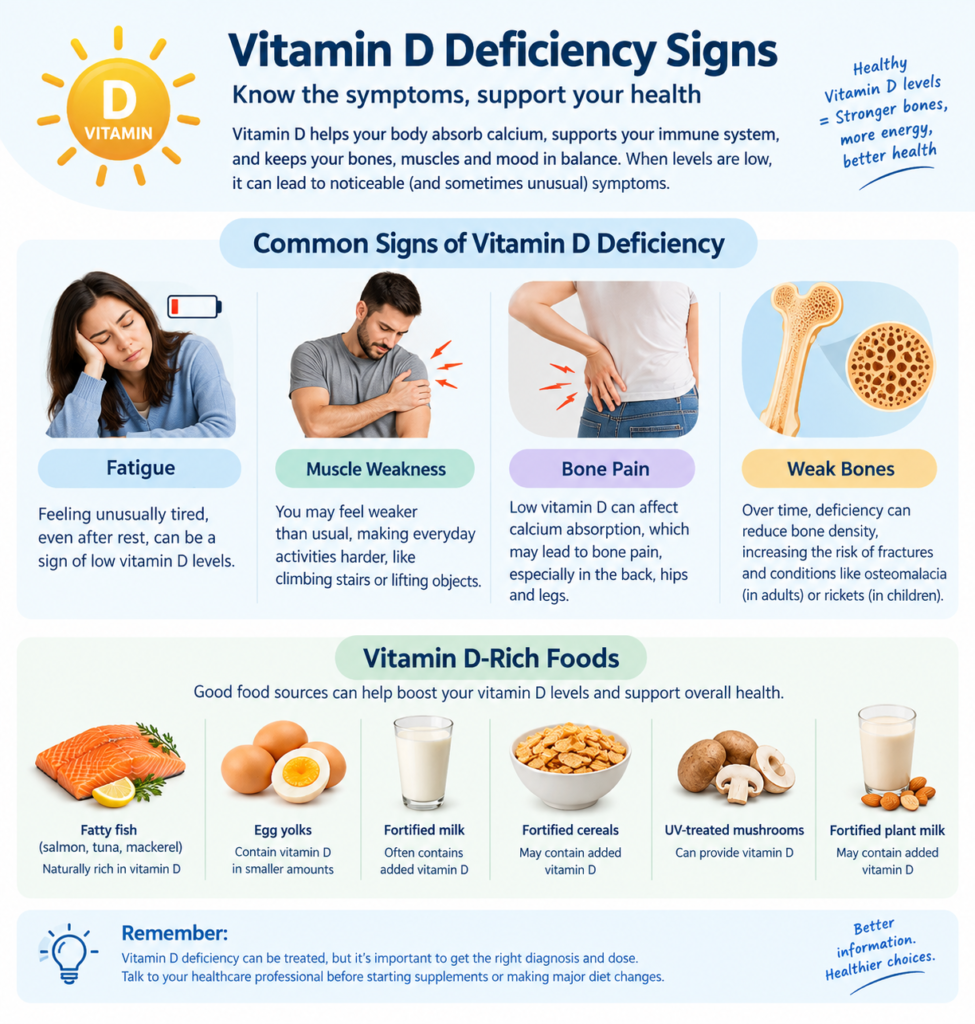
People often report these common symptoms linked to low vitamin D:
1. Persistent fatigue
Most people feel tired now and then, and that is not always a red flag. But if the tired feeling keeps coming back or does not have a clear reason, it may show up with low vitamin D.
Tiredness alone does not point to vitamin D for sure. If you have felt unusually worn out for several weeks, it helps to talk with a clinician first. Do not just blame vitamin D.
2. Muscle weakness
Weak muscles are often linked with a bigger vitamin D shortage.
You may start to notice that daily tasks take more effort. Going up stairs, standing up from a chair, or carrying items you normally handle can feel harder than before.
When vitamin D is very low, muscle weakness can happen with osteomalacia.
3. Bone pain
Low vitamin D can make it harder for the body to take in calcium, and it can affect how bones mineralize.
When the shortage gets worse, some adults report a general ache or pain in the bones. People may not know why it starts. It may feel unlike the usual soreness from working out.
Doctors might suggest a vitamin D blood test if a person has this issue plus other risks or related symptoms.
4. Frequent muscle aches
People who are low on vitamin D sometimes get sore muscles or feel tired in the muscles.
Still, muscle pain can come from many other things. Working out hard, certain medicines, recent injuries, infections, and mineral or electrolyte problems can all lead to soreness.
Because of that, muscle pain by itself does not prove that someone has a vitamin D deficiency.
5. Bone fractures or reduced bone strength
If you do not get enough vitamin D for a long time, your bones may get weaker.
Vitamin D lets your body take in calcium. Calcium is needed to keep bones strong. When vitamin D is very low, bone issues can happen more often.
6. Problems with normal physical activity
A few adults who have a clear lack of something important may see changes in how well they move. Walking may feel harder, or their muscles may seem weaker. If this happens, they should get a medical check instead of trying to fix it on their own with very high doses of vitamin D.
| Expert Tip: Be careful about using only one symptom to judge low vitamin D. If you notice tiredness, sore muscles, or hair changes, that does not confirm the problem by itself. Those signs can show up for many other reasons too. |
Weird Symptoms of Vitamin D Deficiency
People look up weird symptoms of vitamin D deficiency a lot. Many users notice small changes in how they feel and then ask if vitamin D might be behind it.
Still, there is a key point here. An unusual symptom does not automatically mean low vitamin D is the cause.
Online, some symptoms come up again and again. These include feeling very tired, shifts in mood, aches in the muscles, worries about hair, or getting colds more than usual. But the research is not the same for each one. So you cannot treat these as proof that vitamin D is low.
Vitamin D does help with body functions. It supports parts of the nervous system and the immune system. Even so, that does not mean every mood issue or immune problem traces back to vitamin D deficiency.
What about hair loss?
Some websites say low vitamin D can be linked to hair loss.
Still, hair loss can happen for many other reasons. Examples include family traits, shifts in hormones, stress, side effects from certain drugs, thyroid problems, and lack of other nutrients.
Because of that, hair loss by itself is not enough to confirm a vitamin D deficiency.
What about mood changes?
People have looked at whether vitamin D links to mental health. Even so, low vitamin D does not mean it is the cause of depression, anxiety, or any other mental issue.
If your mood keeps shifting for a while, talk with a qualified healthcare provider. Do not count on vitamin D pills by themselves.
| Did You Know? Vitamin D shortage can happen quietly. Someone may look and feel fine, yet their vitamin D level can still be low. |
Vitamin D Deficiency Symptoms in Females
People often look up “vitamin D deficiency symptoms in female” and wonder if women feel it differently.
In most cases, the main symptoms do not change much by gender. Women may show the same key signs seen in other adults. These can include bone pain, sore or weak muscles, and tiredness.
That said, some stages of life can shift the odds. Pregnancy can raise the amount of nutrients needed. As people get older, the body may not make and handle vitamin D as well.
Also, problems that limit how the body absorbs nutrients can raise the chance of a deficiency.
Women may be at greater risk if they get little sun. Risk can also rise with low intake of vitamin D foods. Darker skin can reduce skin production. Extra body weight and gut or absorption issues can also play a role.
Possible signs women may notice
A lack of vitamin D can lead to the following issues in some people:
- Ongoing fatigue
- Weak muscles
- Muscle soreness
- Pain in the bones
- Less strength for daily tasks
- Higher risk of bone trouble when the deficiency gets worse
These signs are not only seen in women. They can happen in adults in general.
If you are pregnant, nursing, trying to conceive, or dealing with any health condition, check with a clinician about vitamin D. Do not pick a high dose on your own.
Vitamin D Deficiency Signs in Children
Kids need vitamin D so their bones can form the right way.
If a child has very low levels, rickets can happen. With rickets, bones that are still growing can turn soft and feel weak. That may slow down how the skeleton develops over time.
The weird symptoms of vitamin D deficiency in kids do not always look like the usual adult complaints. Some kids mainly show changes in how their body grows.
Signs of a serious lack can include the following.
- Pain in the bones or soreness to the touch
- Weak muscles
- Late progress in physical growth
- Trouble with normal bone growth
- Bones that feel soft or not strong
- Bone shape changes in bad cases of rickets
Breastfed babies need extra thought too. Breast milk does not contain enough vitamin D by itself. The NIH says breastfed infants should get 400 IU of vitamin D each day.
Do not give a child a big dose of vitamin D pills unless a clinician tells you to. How much a child needs depends on age, and too much can cause harm.
What Causes Vitamin D Deficiency?
Vitamin D can be low for many causes. It is not only about missing sunlight.
Your body makes and gets vitamin D in a few ways. Sun exposure helps your skin make it. Food can add some amounts. Supplements can help too. If any step in this chain does not work well, levels may drop.
Some common risk factors are listed below.
Limited sunlight exposure
If you do not spend much time outdoors, your skin may make less vitamin D. This can happen with desk jobs, staying inside most of the day, keeping the skin covered, or living in places where sunlight is weaker in parts of the year.
Darker skin
Melanin affects how the skin responds to sunlight. People with more melanin often produce less vitamin D from the sun. The risk goes up further when sun exposure is also low.
Older age
With age, the skin often works less well at making vitamin D. Many older adults also spend less time outside, which can add to the issue.
Limited dietary intake
Very few foods have vitamin D in a meaningful amount. People who follow strict eating patterns may struggle to reach enough unless they choose foods with added vitamin D or use a supplement that fits their needs.
Poor absorption of nutrients
Some bowel conditions can make it harder to absorb vitamins. Crohn’s disease, celiac disease, and ulcerative colitis are examples. Since vitamin D is fat-soluble, problems with absorbing fats can also lower vitamin D uptake.
Obesity
In people with obesity, vitamin D may be less available in the blood. Vitamin D can be stored in body fat instead of circulating where it is needed. This does not mean that every person with
obesity will be deficient, but it is a known risk.
Liver or kidney conditions
The body has to change vitamin D into usable forms. Issues in the liver or kidneys can affect that process. Certain kidney and liver conditions can interfere with this process.
How Is Vitamin D Deficiency Diagnosed?
You cannot tell if you are low on vitamin D just by looking at symptoms.
A clinician may ask for a blood test named 25-hydroxyvitamin D. You may also see it written as 25(OH)D. This test is the usual lab check for vitamin D levels.
Testing is sometimes considered when someone has symptoms, certain health issues, or known risks for low vitamin D.
Still, for most healthy adults, checking vitamin D levels as a routine step is usually not advised. The choice to test depends on the details of your situation.
How to Treat Vitamin D Deficiency
How you treat a vitamin D deficiency depends on several things. Your blood level matters first along with your age. Your overall health can change the plan. Doctors also look for why your level is low.
Most of the time, treatment uses vitamin D pills or drops. If the deficiency is severe, clinicians may start with a higher dose for a short period. After that, you switch to a lower dose to keep levels steady.
1. Vitamin D supplements
If food and sun do not provide enough vitamin D, supplements can help fix the gap.
Vitamin D comes in two main types. The first one is Vitamin D2. Vitamin D3 is another. Your clinician can guide you to the right type and the right amount.
Do not assume you need a big dose just because you feel unwell. Many symptoms have other causes.
The right amount is not the same for everyone. Taking too much vitamin D can raise calcium in the blood. That can lead to serious problems.
2. Eat more vitamin D-rich foods
Food can help you maintain healthy vitamin D levels.
Good sources include:
| Food | Vitamin D contribution |
| Salmon and other fatty fish | Naturally rich source |
| Tuna and mackerel | Naturally contains vitamin D |
| Egg yolks | Contains smaller amounts |
| Fortified milk | Often contains added vitamin D |
| Fortified plant milk | May contain added vitamin D |
| Fortified breakfast cereals | Often fortified |
| Some UV-treated mushrooms | Can provide vitamin D |
You can check food labels to see if a product has been fortified with vitamin D.
Step 3. Get sensible outdoor exposure
Your skin can make vitamin D after it gets sunlight.
But there is not one set amount of sun that fits everyone. Darker or lighter skin can change the result. Where you live matters too. Season and time of day also play a role. Age and what you wear can affect exposure. Other factors can matter as well.
More time in the sun is not always the answer.
Too much ultraviolet light can harm your skin and raise the risk of skin cancer. MedlinePlus says that getting vitamin D from food and supplements may be a safer choice than trying to raise it by sun exposure.
Step 4. Look at what is causing the low level
If your vitamin D stays low even after you take supplements, a clinician might look for the reason.
Some examples are trouble absorbing nutrients, issues with the kidneys or liver, certain drugs, or not getting enough from food.
Fixing the root cause can matter as much as taking vitamin D.
Vitamin D Foods and Daily Requirements
How much vitamin D you need depends on your age and life stage.
According to the NIH, the recommended dietary allowance is generally:
| Age or life stage | Recommended amount |
| Birth–12 months | 400 IU (10 mcg) |
| 1–70 years | 600 IU (15 mcg) |
| Adults over 70 | 800 IU (20 mcg) |
| Pregnancy and breastfeeding | 600 IU (15 mcg) |
These amounts are meant as general guidance. They are not the same thing as doses used to treat a known deficiency.
If someone has a confirmed deficiency, their dose might be changed for a while. That should happen only with a clinician watching.
FAQs
How can I increase my vitamin D fast?
A careful approach is best. Spend time in sunlight safely, eat foods that contain vitamin D, and use supplements only if a clinician says you should. If your tests confirm you are low, your doctor might suggest a short higher dose and then a lower daily dose.
What food is high in vitamin D?
You can find vitamin D in fatty fish like salmon, trout, sardines, and tuna. You may also get it from egg yolks. Fortified milk and fortified plant milks can help too. Fortified cereals add more. Some UV-treated mushrooms also have vitamin D.
What happens if my vitamin D levels are low?
Low vitamin D can make it harder for your body to use calcium. That can lead to bone aches, weak muscles, and bones that do not stay strong. In kids, serious or long-lasting low levels can lead to rickets. In adults, it can lead to osteomalacia.
Which organ is affected by vitamin D deficiency?
It is not limited to one organ. Most of the impact shows up in bones and muscles. Vitamin D supports calcium balance and bone health. With very low levels, muscle function can also suffer, along with other body tasks that rely on enough vitamin D.
What are 5 signs of vitamin D deficiency to not ignore?
Common signs to talk about with a healthcare professional include ongoing tiredness, muscle weakness, bone pain, more frequent fractures, and trouble keeping bones strong. These can point to other issues as well. A blood test may be needed to confirm whether vitamin D is the cause.
Conclusion
In the UK, the NHS advises vitamin D supplements for some groups who face higher risk. This includes people who get little sun. It also includes people with darker skin.
Recognizing vitamin D deficiency signs can make it easier to know when to get help. Feeling tired, having weak muscles, noticing muscle aches, or dealing with bone pain may show up. Still, a lot of people do not notice anything clear.
Most cases can improve with the right mix of supplements, food, and finding the real reason the level is low. Even so, large doses should not be taken on your own. Without guidance, high amounts can cause harm.
If symptoms do not go away, or if you have more than one risk factor, it is smart to talk with a clinician. A blood test for 25-hydroxy vitamin D can show if your level is truly low.
For more health content, check Healthases’ guide on [effective psoriasis treatments at home]. If you have questions, go to our [Contact Us page].
You can also read how we handle health info in our [Health Disclaimer].
If this article helps, share it with someone else. You can also subscribe to Healthases.com for more practical health and wellness guidance based on evidence.
Author Information
Written by: Healthases Editorial Team
Healthases Editorial Team puts together health and wellness articles that are easy for readers to follow. We base our work on trusted medical sources and on findings supported by research and aim to help people understand health topics in plain terms. We also want readers to reach out to a qualified medical professional when that makes sense.
Follow us on Instagram | Follow us on Facebook | Follow us on LinkedIn
Medical Disclaimer
This text is meant to share general information. It is not a replacement for advice from a licensed clinician. It should not be used to diagnose an illness, manage symptoms, cure a condition, or stop disease.
How much vitamin D someone needs can differ from person to person. Age, current health issues, meds being taken, pregnancy, lab test findings, and other personal details can all affect dosing. Talk with a qualified healthcare professional before you begin a large dose of vitamin D or before you change your current plan.
References
- National Institutes of Health — Office of Dietary Supplements. Vitamin D Fact Sheet for Health Professionals.
- MedlinePlus — U.S. National Library of Medicine. Vitamin D Deficiency.
- MedlinePlus — U.S. National Library of Medicine. Vitamin D Test.
- NHS. Vitamin D — Vitamins and minerals.
- Mayo Clinic. Vitamin D deficiency. Updated May 10, 2025.
- Mayo Clinic. Vitamin D — Drugs and Supplements.

Leave a Reply