

Last updated: June 2026 | Written by: Healthasee Editorial Team | Reviewed by: Fitness & Wellness Research Desk | Read time: 13 minutes
Medical Disclaimer: This article is for informational and educational purposes only and should be treated as such. It does not replace professional medical guidance. If you already have any health conditions, injuries, or other worries, please talk with your doctor before beginning a new fitness routine
This post has affiliate links. If you buy through our links, we might earn a small commission, but it is at no extra cost to you. We only recommend products that we have really looked into, genuinely researched, or at least that’s the intent.
A morning workout routine is basically a set of physical exercises you do soon after waking up, usually within 30 to 90 minutes after getting up. The best morning routines mix a quick 5-minute warm-up, about 20 to 30 minutes of work (cardio, strength, or a blend), and then a 5-minute cool-down. Ideally you repeat it 4 to 5 days every week, so you can actually track improvements in fitness, fat loss, and daily energy.
Most people already *know* they should exercise in the morning. Far fewer do it, and the ones who do often stop within just two weeks. Usually it’s because they chose something too punishing, too tricky, or just not right for where they’re at fitness-wise. Then the whole thing turns into, “I failed” in their head; they bail, and they end up skipping workouts again.
This guide changes that. Here you’ll get a full morning workout routine at home that really works whether you are brand new, a man who wants more intensity, or someone who only needs an easy, no-excuses 20-minute routine. Each plan below needs zero gym membership and minimal tools, so you can start without making it harder than it needs to be.
Key Takeaways
- Morning exercise kinda boosts your metabolism by 15–20% for the rest of the day, and yeah, you end up burning more calories even while you’re just sitting at a desk.
- People who work out in the morning are about 90% more likely to keep up their routine than those who train at night, according to a few separate studies.
- If you do a 20–30 minute workout at home in the morning, you can get the same fat loss results as a 45-minute gym session, but only if you do it correctly, and not half-heartedly.
- For beginners, the best morning plan is basically the one that avoids heavy intensity during week 1, because consistency weighs more than sheer effort in the first 30 days.
- Also, doing cardio before breakfast (fasted cardio) can burn up to 20% more fat than exercising after breakfast, although both options are still very effective either way.
Table of Contents
- Why a morning workout routine beats exercising at any other time
- What to do before you start: preparation checklist
- The perfect 5-minute warm-up for any morning workout
- Best morning workout routine at home for beginners
- Complete 7-day morning workout routine plan
- Morning workout routine for men intermediate level
- Simple morning workout routine 15 minutes, no excuses
- Early morning workout routine for 5 am to 6 am risers
- Frequently asked questions
Why a Morning Workout Routine Beats Exercising at Any Other Time
Before you build your good morning workout routine, it kind of helps to know why the timing genuinely matters not only for motivation, but also for the way your body works. The science about getting moving in the morning is actually more convincing than most people realise, and it can explain why those who train in the morning keep showing better results than evening exercisers when it comes to long-term habit building.
Your Cortisol Levels Are Naturally Elevated in the Morning
Cortisol, often also called the stress hormone, seems to ride a daily rhythm in your body. It usually climbs up between 6 am and 8 am during your waking process, or whatever you call that morning switch. That early high is not a bad deal in the morning context; it helps move energy along, sharpens attention, and it sort of primes your muscles for physical activity. So when you exercise inside that natural cortisol window, your system feels hormonally ready to do the work and yes, to burn fat more readily. Then by evening, cortisol drops, and your body starts shifting into a more rest and recovery mode, which can make it physiologically harder to power through heavy, intense workouts.
Morning Exercise Boosts Metabolism All Day Long
When you wrap up a morning workout routine, your metabolic rate is kinda still high for 4 to 8 hours after that; this is the Excess Post-Exercise Oxygen Consumption, also known as EPOC. So basically, every hour you spend just sitting at your desk, stuck in a meeting, or watching television after you trained in the morning, your body keeps burning a few extra calories than it would have if you never exercised at all. For weight loss, that’s a real benefit, and people who exercise later in the afternoon or evening don’t get that same kind of advantage in the same way.
The Science
A study in the British Journal of Nutrition, said people who worked out before breakfast burned about 20% more fat than those who exercised after they ate. Another study, in Obesity, also reported that morning exercisers were clearly more active during the rest of the day compared with evening exercisers, kind of suggesting that moving earlier triggers a good sequence of physical activity that keeps building as time goes on.
Consistency Is the Real Winner, and Morning Wins for Consistency
The most important factor in any exercise programme is basically whether you end up doing it. Evening workouts face this daily obstacle thing: work running late, family commitments, social events, plain old tiredness, and that really seductive urge to just flop down and sit after a long day. Morning workouts are sort of different because they happen before the day gets its claws in. Research from the American College of Sports Medicine suggests that people who exercised in the morning kept their routine at about a 90% rate, while those who exercised in the evening managed only around 50%.
Did You Know?
Morning workouts apparently help your sleep quality that very night, by about 100%. Researchers from Appalachian State University noticed that folks who moved their bodies around 7 am slept for longer, and they also had more intense, deeper sleep cycles than people who exercised at 1 pm or 7 pm. And with better sleep happening first, hunger-related hormones tend to drop the next day, which kinda starts this small but real virtuous cycle between morning exercise and healthy weight management.
What to Do Before You Start: Preparation Checklist Morning Workout Routine
The biggest reason people fail at a morning workout routine at home is not because of motivation it is more like a lack of preparation, honestly. When you wake up and all the things you need are already set up, the choice to exercise feels almost effortless. But if you have to look for your clothes, clear out space, and also figure out what to do while you are still half asleep, then the resistance becomes way too high; it just blocks you.
The Night Before Your Preparation Checklist
- Get your workout clothes ready the night before, including socks and shoes
- Make the space clear around where you’ll move (even like a 2m x 2m area is more than enough for most at-home routines)
- Put the exercise mat near your bed, or just place it in your workout zone
- Set your alarm 10 minutes earlier than your usual start time, so you can wake up properly
- Have a glass of water ready so you can drink right after you open your eyes
- Pick the workout you’ll do from this guide, and jot it down on a sticky note or in your phone
- If you’re using music, build a playlist the night before, so it’s there waiting for you
Should You Eat Before a Morning Workout?
This is one of those most searched questions people ask about early morning workout routines, and honestly the answer is kind of dependent on your goal and your workout intensity too.
| Goal | Eat before? | What to eat (if yes) |
| Fat loss/weight loss | Optional — fasted is slightly better for fat burn | If needed: half a banana or black coffee |
| Muscle gain/strength | Yes — eat 20–30 min before | Banana + protein shake or 2 boiled eggs |
| General fitness/energy | Light snack recommended | Small handful of nuts or a date with water |
| High-intensity (HIIT, sprints) | Yes — small carb snack | Half a banana or 1 slice whole wheat toast |
Make it a habit to drink not less than 250 ml of water before you even begin an early morning workout routine. After 7 to 8 hours of sleep, your body is usually a bit underhydrated, and honestly, even mild underhydration can cut exercise performance by as much as around 10%.
Recommended product:
A good quality gym water bottle with time markings helps you track water intake throughout your workout and the rest of your day.
Shop on Amazon; look for BPA-free options with at least 1 litre capacity.
The Perfect 5-Minute Warm-Up for Any Morning Workout
Never skip the warm-up. This applies to every single morning workout routine, beginner, intermediate, or advanced. In the morning especially, your muscles and joints have been still for 7 to 8 hours, and they are not ready for sudden intense movement. Skipping the warm-up is kinda the single biggest cause of morning workout injuries and that sore feeling that makes people skip the next day too.
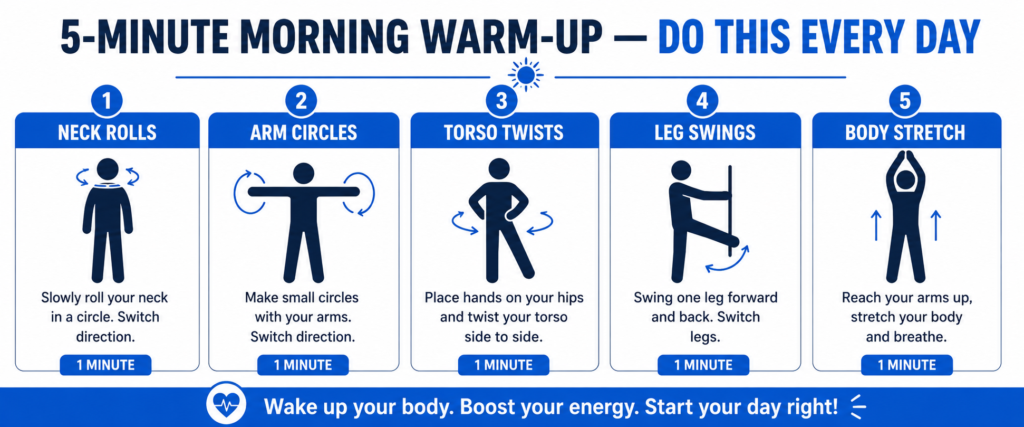
Do this exact warm-up sequence before every routine in this guide:
Warm-Up Sequence 5 Minutes Total
- Minute 1: March in place: Lift your knees to hip height and swing opposite arms. This kind of thing raises your heart rate gently and also wakes up your legs and core a bit.
- Minute 2: Arm circles: 20 seconds forward, 20 seconds back, 20 seconds shoulder rolls. It loosens the shoulders, neck, and upper back. That area usually feels kinda tight after sleep.
- Minute 3: Hip circles plus hip hinges: do 30 seconds rotating hips in big circles, 30 seconds bending forward with soft knees, then return upright. This opens up your lower back and hip flexors, which is honestly pretty helpful.
- Minute 4: Ankle rolls and calf raises: 20 ankle circles per foot, then 20 calf raises. It preps your ankles and knees for any jumping or other lower body movement.
- Minute 5: Light jumping jacks, or step jacks: 60 seconds at a slow to medium pace. Brings your heart rate into the moderate zone, so your cardiovascular system is primed and ready.
Total: 5 minutes | Zero equipment | Safe for all fitness levels
Best Morning Workout Routine at Home for Beginners
If you’re new to exercise or kind of returning after a long pause, this is your starting point, ok. The best morning workout routine for beginners isn’t the most intense one; it’s the one you can realistically finish every day without feeling annoyed by it. In the first two weeks, the whole goal isn’t “fitness” as such; it’s habit, like actually building it up. Fitness tends to show up by itself once the habit is already solid, you see.
This routine is about 25 minutes total, including the warm-up part. Do it 4 to 5 days per week for the first two weeks, then move into the 7-day plan below.
Exercise 1: Bodyweight Squats
Start standing with feet about shoulder-width apart. Lower yourself kind of like you’re sitting back into an invisible chair until your thighs are pretty much parallel to the floor (or as far down as you feel good). Then rise back up, repeat. Keep your chest up, and try to make sure your knees are gliding over your toes the whole time.
3 sets × 12 reps | Rest: 30 seconds between sets | Targets: thighs, glutes, core
Exercise 2: Push-Ups (Modified if Needed)
Get into a high plank position, hands just a bit wider than shoulder-width. Lower your chest toward the floor while keeping your body in one straight line, then press back up. If full push-ups are kinda hard, switch to knee push-ups… same pattern, but with your knees on the floor. Over 2 or 3 weeks, gradually build toward doing full push-ups without stopping.
3 sets × 8–12 reps | Rest: 30 seconds | Targets: chest, shoulders, triceps, core
Exercise 3: Plank Hold
Hold a forearm plank, elbows right under your shoulders. Keep your body in a straight line from head to heels, core tight (braced) the whole time. Beginners can start around 20 seconds, and then add time until you reach 60 seconds during the first month. Honestly, this is one of the best core routines you can do in a simple morning workout routine, because it works your entire midsection at the same time, like all at once.
3 sets × 20–45 seconds | Rest: 20 seconds | Targets: core, shoulders, back
Exercise 4: Glute Bridges
Lie on your back with knees bent, and place your feet flat on the floor about hip-width apart. Push your feet into the ground and lift your hips until your body makes a straight line from knees to shoulders. Squeeze your glutes up top for about 1 second, then lower yourself slowly. This is great for waking up the posterior chain, the muscles people use less because they sit all day.
3 sets × 15 reps | Rest: 20 seconds | Targets: glutes, hamstrings, lower back
Exercise 5: Walking Lunges
Put your right foot forward and let your left knee lower toward the floor; don’t let it touch, though. Push through your right foot, then slide the left foot forward into the next lunge. Keep moving ahead for the whole set, no stopping in between. If space gets tight, just do alternating lunges that stay in place. Lunges are kind of a cornerstone in nearly every effective morning workout routine at home, since they improve stability, coordination, and leg strength at the same time.
3 sets × 10 reps each leg | Rest: 30 seconds | Targets: quads, glutes, hamstrings
Exercise 6: Mountain Climbers
Get into a high plank, hands under shoulders. Bring your right knee forward toward your chest, then fast switch to the other side: left knee in, right knee back. Go on alternating like you are running in place, but keep hips level and keep your core tight. Mountain climbers pair core work with cardio, so they end up being one of the most time-efficient exercises in a good morning workout routine.
3 sets × 20 seconds | Rest: 20 seconds | Targets: core, shoulders, hip flexors, cardio
Expert Tip For True Beginners
In your first week, do 2 sets of each exercise only, instead of 3. Your muscles aren’t used to this kind of demand yet, so soreness is likely after the first session. That’s normal. People call it Delayed Onset Muscle Soreness (DOMS), and it tends to peak around 24 to 48 hours after you train. On day 2, move gently, and it should ease a lot by week 2.
Complete 7-Day Morning Workout Routine Plan
This is like a complete structured week of training, your full morning workout routine mapped out day by day. Every day has some different focus so your muscles get that adequate recovery while you keep training in a steady rhythm. So just follow the plan from week 3 onwards, once you already built the basic habit with the beginner routine up above.
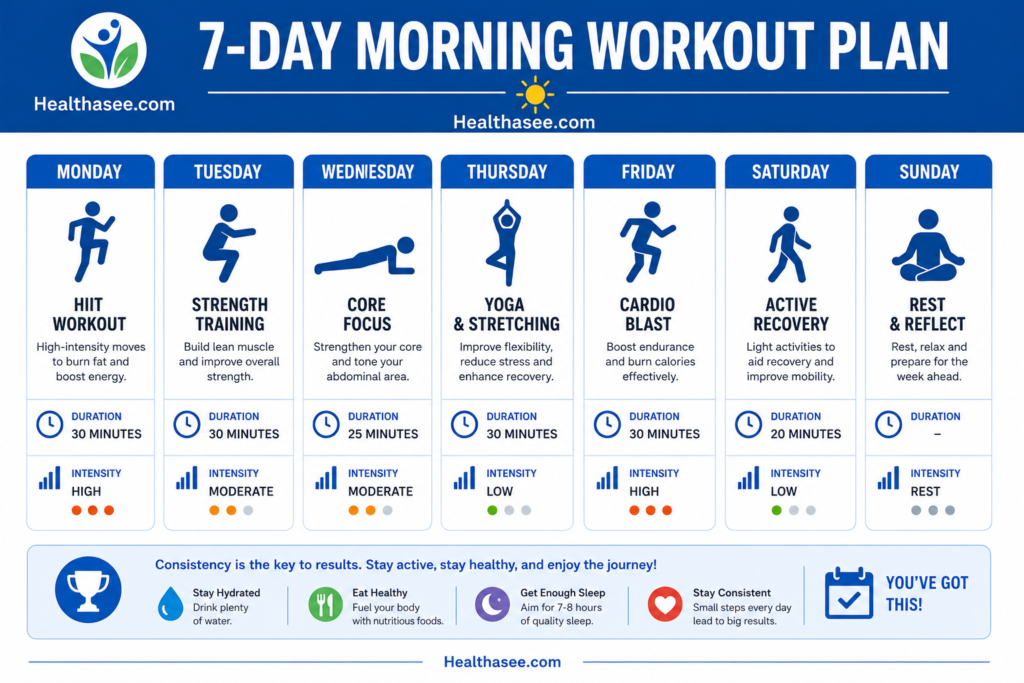
Monday: Full body HIIT, yeah pretty intense
High intensity
Duration: 5-min warm-up + 25-min workout + 5-min cool-down = total 35 minutes
Workout plan: 40 seconds work / 20 seconds rest, per exercise, and you do 3 rounds
Jumping jacks, then squat jumps, then push-ups, mountain climbers, high knees → burpees
Goal: get the highest calorie burn and solid cardio conditioning so you start the week strong, kinda like a nudge for your whole system
Tuesday: Lower Body Strength
Medium Intensity
Duration: 5-min warm-up + 25-min workout + 5-min cool-down = 35 minutes
Workout: 3 sets × 12–15 reps, 30 seconds rest:
Bodyweight squats → Walking lunges → Glute bridges → Sumo squats → Calf raises → Wall sit (45 seconds)
Goal: Strengthen the largest muscle groups in your body — legs and glutes — they do a lot of work and yes, burn the most calories even when you are resting
Wednesday: Active Recovery Walk
Low Intensity
Duration: 30–45-minute brisk walk outdoors, or on a treadmill
Goal: Active recovery, keeps your body moving without putting extra stress on your muscles. Walking on recovery days supports muscle repair, reduces soreness, and adds extra calorie burn with a low-effort feel. This is a nonnegotiable part of your early morning workout routine.
Thursday: Upper Body Strength
Medium Intensity
Duration: 5-min warm-up + 25-min workout + 5-min cool-down = 35 minutes
Workout: 3 sets × 10–12 reps, 30 seconds rest:
Push-ups → Tricep dips using a chair → Pike push-ups → Superman holds → Plank (45 seconds) → Side plank (30 seconds each side)
Goal: Build upper body strength, plus shoulder stability. No weights needed — bodyweight is more than enough to build real muscle; just take the reps close to near-failure
Friday: Cardio and Core
High Intensity
Duration: 5-min warm-up + 25-min workout + 5-min cool-down = 35 minutes
Workout: Jump rope 3 minutes → Core circuit (crunches, leg raises, bicycle crunches, reverse crunches) 3 rounds of 45 seconds each → Jump rope 3 minutes → Repeat
Goal: Cardio conditioning paired with direct abdominal work. This combo helps reduce belly fat and builds core definition at the same time. Internal link → “how to lose belly fat by exercise”
Saturday: Full Body Strength Circuit
Medium Intensity
Time: 5-min warm-up + 30-min workout + 5-min cool-down ,so total 40 minutes
Workout: Do 4 rounds of the whole thing with 60 seconds rest between rounds
10 push-ups → 15 squats → 20 mountain climbers → 12 glute bridges → 10 lunges each leg , then 30-second plank
Goal: Full body muscular endurance. By Saturday, your body has sort of adapted to the week’s training, and this circuit basically stitches in the progress you built earlier
Sunday: Full Rest
Rest day
Activity: Full rest, or a gentle stretch/yoga session for 15 to 20 minutes
Goal: Muscle repair and recovery. Rest isn’t being lazy; it’s when your muscles actually rebuild and get stronger. If you skip rest days, you risk overdoing it, progress slows down, and injury chances go up. You can’t really grow your fitness if recovery is missing
Recommended products for your home morning workout:
- Non-slip exercise mat (6mm): essential for all floor exercises. Shop on Amazon
- Adjustable jump rope: used on Fridays and HIIT days. Shop on Amazon
- Resistance bands set: adds intensity to squats, glute bridges, and upper body work without weights. Shop on Amazon
Morning Workout Routine for Men Intermediate Level
So this morning workout routine for men, like outlined here, is sort of made for guys who already have like 4 to 6 weeks of solid training behind them and are trying to push both strength up and fat loss along with it. Most men usually have higher testosterone levels and more muscle mass than women, and because of that they can usually manage a higher training volume, plus recover faster. Still, that same advantage sometimes makes them underestimate rest, and also these mobility work things that feel kinda boring at first.
Monday, Wednesday, Friday: Push / Pull / Legs Split
| Day | Focus | Key Exercises | Duration |
| Monday | Push (chest, shoulders, triceps) | Wide push-ups, diamond push-ups, pike push-ups, triceps dips, plank shoulder taps | 35–40 min |
| Wednesday | Pull (back, biceps) | Superman holds, reverse snow angels, towel rows (using a door), resistance band pull-aparts | 35–40 min |
| Friday | Legs and glutes | Jump squats, Bulgarian split squats, single-leg glute bridges, lateral lunges, calf raises | 35–40 min |
Tuesday, Thursday: Cardio and Core
For Tuesday, do HIIT. Then on Thursday stick with steady pace cardio like brisk walking or cycling, not too wild, you know. Finish each cardio session with about 10 minutes of core stuff: leg raises, bicycle crunches, and planks; kinda mix it up, keep going.
Expert Tip For Men, Specifically
One of the most common little errors men do with a morning workout routine for men is basically forgetting mobility and recovery stuff entirely. After a while, tight hip flexors, weaker shoulder range of motion, and a stiff thoracic spine start acting like real performance roadblocks. Just take 5 minutes after each workout for focused stretching: hip flexor stretch, chest opener, and hamstring stretch; then your results should get noticeably better within about 4 weeks.
Recommended product:
A foam roller is kinda one of the most useful recovery tools for guys doing steady morning training. it helps push out muscle tightness, and it also stops the built-up stiffness, the one that usually turns into injury.
Go browse and shop foam rollers on Amazon. Try to pick high-density versions for a deeper muscle release, you know, more intensive kneading and better relief.
Simple Morning Workout Routine 15 Minutes, No Excuses
Life is busy. Some mornings you only have 15 minutes and not a second more, even if you swear you’re “almost there”. This simple morning workout routine is made for exactly those mornings. It is not the optimal workout, not even close, but it is infinitely better than doing nothing at all. When you stick with it, even this 15-minute routine brings real results over 8 to 12 weeks.
No equipment. No warm-up needed at this intensity. Do each exercise for 45 seconds, with 15 seconds rest:
The 15-Minute Simple Routine: 3 Rounds of 5 Exercises
- Exercise 1: Jumping Jacks (45 sec): Raises heart rate and, in the same moment, warms up most of the body. If jumping feels too loud or a bit harsh on the joints, switch to step jacks instead.
- Exercise 2: Bodyweight Squats (45 sec): Hits the biggest muscle groups you’ve got, so you get a strong calorie burn for the shortest amount of time.
- Exercise 3: Push-Ups (45 sec): Works the upper body along with the core. Drop to your knees if you need, but keep the motion right, not just the style.
- Exercise 4: High Knees (45 sec): Do a run in place, pulling your knees up until they reach hip height. It’s one of the best burn-quick exercises when you’re stuck in a small area.
- Exercise 5: Plank (45 sec): Hold either a forearm plank or go for a high plank. Core engagement, plus shoulder stability, keep your whole body tight and steady.
Rest 60 seconds between each round. Do 3 rounds for a total of 15 minutes.
Total: 15 minutes | Calories: 120–180 | Zero equipment | Any space
Even this kinda simple morning workout routine, done 5 days per week, burns about 600 to 900 extra calories each week, which is enough to help you drop roughly 1 to 1.5 kg of fat over a month, once you pair it with sensible eating habits.
Early Morning Workout Routine For 5 am to 6 am Risers
An early morning workout routine at 5 am or 6 am is kinda a different challenge than one at 7 am or 8 am, mostly because your body temperature is lower, your nervous system is less activated, and your thinking ability is still ramping up. So it takes a few specific tweaks to make sure the whole session stays safe, works well, and is doable over time, not just in theory.
Key Adjustments for Early Morning Training
Extend your warm-up to 8 to 10 minutes: Honestly, at 5 am your muscles and joints are just way colder and stiffer than later in the morning. If you hurry through the warm-up at this time, you end up raising injury risk, quite a lot even.
Keep the intensity moderate for the first 10 minutes: Because at 5 am your cardiovascular system needs more time to get in gear. Start with lower-body work and then slowly build intensity, not start straight away with HIIT.
Have cold water immediately after waking up: that little cold-water shock boosts alertness and sort of kickstarts your body’s temperature regulation system.
Avoid heavy strength training during the first week; your tendons and ligaments are at their most vulnerable in those very early hours. Let things build over 2 to 3 weeks before you even think about near-maximum efforts.
Go to bed 30 minutes earlier: It feels obvious, but a lot of early risers still ignore it. That 5 am routine only stays sustainable if you are actually getting 7 to 8 hours of sleep. Training at 5 am on 5 hours of sleep ramps up cortisol, slows recovery, and makes the whole program feel like it’s working against you.
The Science of Early Morning Exercise
Research from the University of Padova indicates that people who worked out between 5 am and 7 am had noticeably lower resting blood pressure across the whole day, with an average drop around 10% compared to people who didn’t exercise at all, and compared with those who exercised later in the day. It also seems the effect gets strongest for the folks who show up early and keep at it, as they stuck to that morning routine for over 8 weeks.
Last Thoughts
A morning workout routine is honestly one of the highest-return habits you can build. The research is pretty detailed: people who exercise in the morning tend to stay consistent, burn more fat across the whole day, sleep better at night, and say they have more energy and better mood levels than folks who work out later, or not at all.
The “perfect” routine isn’t the wildest one, and it isn’t the most complicated one either. It’s the one you will actually do tomorrow morning. Start with the beginner plan, and run it for two weeks. Then move to the 7-day plan. Stick with it for 8 weeks with real consistency, and the changes in how you feel and how you look will surprise you.
The toughest part of a morning workout routine at home is the first step out of bed. After that, the sweat, the burn, the endorphins- it all becomes the reward. Set your alarm, lay your clothes out tonight, and just start tomorrow.
Read next on Healthasee.com:
- https://healthases.com/transform-your-body-with-a-7-day-protein-diet-plan-for-weight-loss/
- https://healthases.com/top-high-protein-foods-less-calories-for-easy-weight-loss/
- https://healthases.com/semaglutide-6-week-belly-ozempic-weight-loss-before-and-after/
- https://healthases.com/intermittent-fasting-benefit-guide-for-beginners/
Healthasee Editorial Team
The Healthasee editorial team makes evidence-based fitness and wellness content for readers around Pakistan and beyond. Every workout program and health claim in our articles is checked against peer-reviewed studies and verified by trusted health authorities before it goes live. Our mission is, kind of straightforward: bring dependable health guidance within reach for everybody, yes even when you’re short on time and energy.
Follow on Instagram | Follow on Facebook | Follow on LinkedIn
References & Sources
- Hackney, K.J. et al. (2010). Exercise and circadian cortisol rhythms. Applied Physiology, Nutrition, and Metabolism. PubMed
- Gonzalez, J.T. et al. (2013). Breakfast and exercise contingently affect postprandial metabolism. British Journal of Nutrition. PubMed
- Fairbrother, K. et al. (2014). Effects of exercise timing on sleep architecture. Vascular Health and Risk Management. PubMed
- American College of Sports Medicine. (2022). ACSM’s Guidelines for Exercise Testing and Prescription. acsm.org
- Mayo Clinic. (2024). Exercise: 7 benefits of regular physical activity. mayoclinic.org
- World Health Organization. (2022). Physical activity guidelines — adults aged 18–64. who.int